

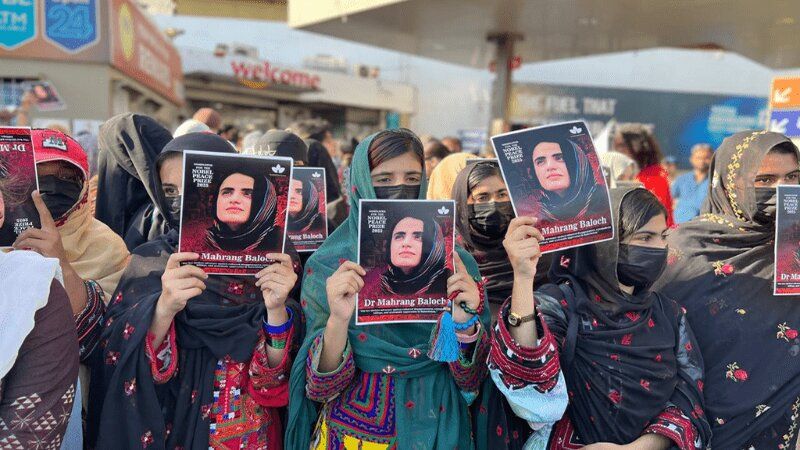
According to Pakistan news media, Dawn News, the Karachi police on Monday dispersed a protest held by the Baloch Yakjehti Committee (BYC) at the Karachi Press Club (KPC) and arrested six people, including activist Sammi Deen Baloch. The demonstration was organized in response to the recent arrests of BYC leaders, including Dr. Mahrang Baloch, and a crackdown on a sit-in protest in Quetta.
Dr. Mahrang Baloch and 16 other activists were arrested in Quetta on Saturday after BYC claimed that three protesters had died due to police action. In reaction, BYC called for protests across Karachi and Quetta. However, Karachi Commissioner Syed Hassan Naqvi imposed a ban on all public gatherings under Section 144 of the Criminal Procedure Code (CrPC), citing security concerns. Despite the ban, BYC supporters gathered near KPC, where they were met with heavy police resistance at Fawara Chowk. Police eventually dispersed the protesters and arrested six individuals, including Sammi Deen Baloch.
A BYC supporter, Sadaf Ameer, whose father has allegedly been forcibly disappeared, stated, “We came to protest peacefully, but the state responded with violence and arrested our people.” According to South Deputy Inspector General of Police (DIG) Syed Asad Raza, the arrests were made due to the violation of Section 144, and the detainees were held at the Women Police Station.
The crackdown on the protest triggered concerns from human rights organizations. Front Line Defenders, an Irish-based human rights group, condemned the arrests and demanded the immediate release of the detained activists. Meanwhile, civil society activists gathered outside the police station in Karachi to show their support.
In a parallel development, counter-protests took place near the KPC, where demonstrators held placards linking BYC to the banned Balochistan Liberation Army (BLA) and India’s intelligence agency, RAW. Some counter-protests were reportedly organized by the Pakistan Ulema Council. Despite the Section 144 ban, these counter-protests were not met with the same police action.
Meanwhile, protests continued in Balochistan. In Panjgur, police used tear gas to disperse demonstrators as a shutter-down strike entered its third day. BYC alleged that security forces fired on protesters in Quetta, leaving several people critically injured. The group has been advocating against enforced disappearances and what they describe as state violence against peaceful protesters. Protests also took place in Kalat, where demonstrators raised slogans condemning police brutality and forced disappearances.
Dr. Mahrang Baloch remains detained in Quetta District Jail under the Maintenance of Public Order (MPO) provisions. Her sister, Nadia Baloch, said that only she was allowed to meet Mahrang after pleading for three hours. According to Nadia, Mahrang appeared strong and encouraged her supporters to continue their peaceful struggle for justice. However, Mahrang has reportedly not been informed of the charges against her and is kept isolated from other prisoners.
International voices have also raised concerns over the situation. Nobel Peace Prize laureate Malala Yousafzai expressed her support for Mahrang Baloch, stating that she was “disturbed and concerned” about the arrest. She emphasized that Mahrang represents “millions of voiceless people facing human rights violations in Balochistan and Khyber Pakhtunkhwa” and called for her immediate release. Additionally, international human rights lawyer Kurtulus Bastimar announced plans to take the matter of Mahrang’s “arbitrary arrest and detention” to the United Nations Working Group on Arbitrary Detention.
The Karachi commissioner’s order under Section 144 remains in effect until March 31, 2025. The restrictions are imposed due to what authorities describe as security threats. However, critics argue that these bans disproportionately target Baloch activists while allowing counter-protests to proceed without intervention.
With protests and crackdowns intensifying, the situation has drawn both national and international attention, raising concerns over Pakistan’s human rights policies and freedom of expression.





