A senior United Nations official issued a stark assessment of Gaza’s devastation on Thursday, describing conditions as “inhumane” and calling for immediate reconstruction efforts as a fragile ceasefire entered its second phase, according to Arab News.
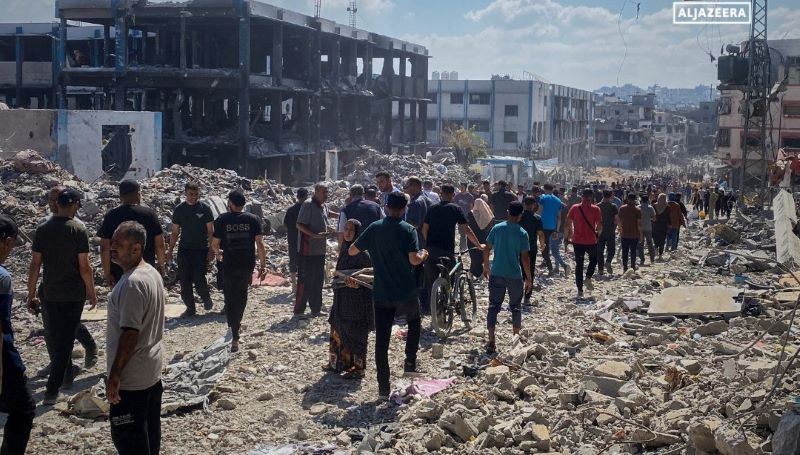
“I wouldn’t have imagined what I saw today, which is total destruction, not much is standing,” Jorge Moreira da Silva, director of the UN Office for Project Services, told journalists following a tour of the Palestinian territory.
The two-year conflict between Israeli forces and Hamas has inflicted unprecedented ruin across Gaza, reducing vast residential neighborhoods, hospitals, schools, and critical infrastructure to rubble. Hundreds of thousands of displaced Palestinians now subsist in makeshift shelters amid the wreckage.
Da Silva characterized the launch of phase two of the ceasefire agreement as a “historical” opportunity that must catalyze reconstruction. “We can’t wait, we can’t procrastinate,” he emphasized, warning against delaying action while Gazans endure catastrophic living conditions.
A joint assessment by the World Bank, United Nations, and European Commission estimates comprehensive reconstruction will require fifty-two billion dollars. However, da Silva stressed the urgency of beginning smaller-scale recovery initiatives immediately, rather than awaiting the massive funding required for complete rebuilding.
The territory of 2.2 million inhabitants now contends with approximately sixty million tons of debris, a staggering accumulation complicated by unexploded ordnance, hazardous materials, and human remains scattered throughout the rubble.
“Gaza is flooded by rubble and debris,” da Silva observed. “The problem isn’t just the volume, it’s the content, which raises serious concerns.”
The environmental specialist identified several critical priorities: ensuring reliable fuel access for electricity generation, demining operations, reconstructing water infrastructure, lifting aid restrictions, and permitting entry of repair equipment and spare parts.
Humanitarian organizations have repeatedly protested difficulties importing essential supplies, attributing obstacles to Israeli restrictions. Israel disputes these accusations, maintaining that its oversight of incoming goods serves legitimate security purposes.
Wednesday’s announcement by US Middle East envoy Steve Witkoff that phase two had commenced aims to facilitate reconstruction while pursuing demilitarization of armed factions. The conflict began with Hamas’s October 7, 2023 attack on Israel, triggering an Israeli offensive that has devastated a territory already weakened by previous hostilities and a blockade imposed since 2007.